Graph Convolutional Networks
Convolution, generalized from grids to graphs.
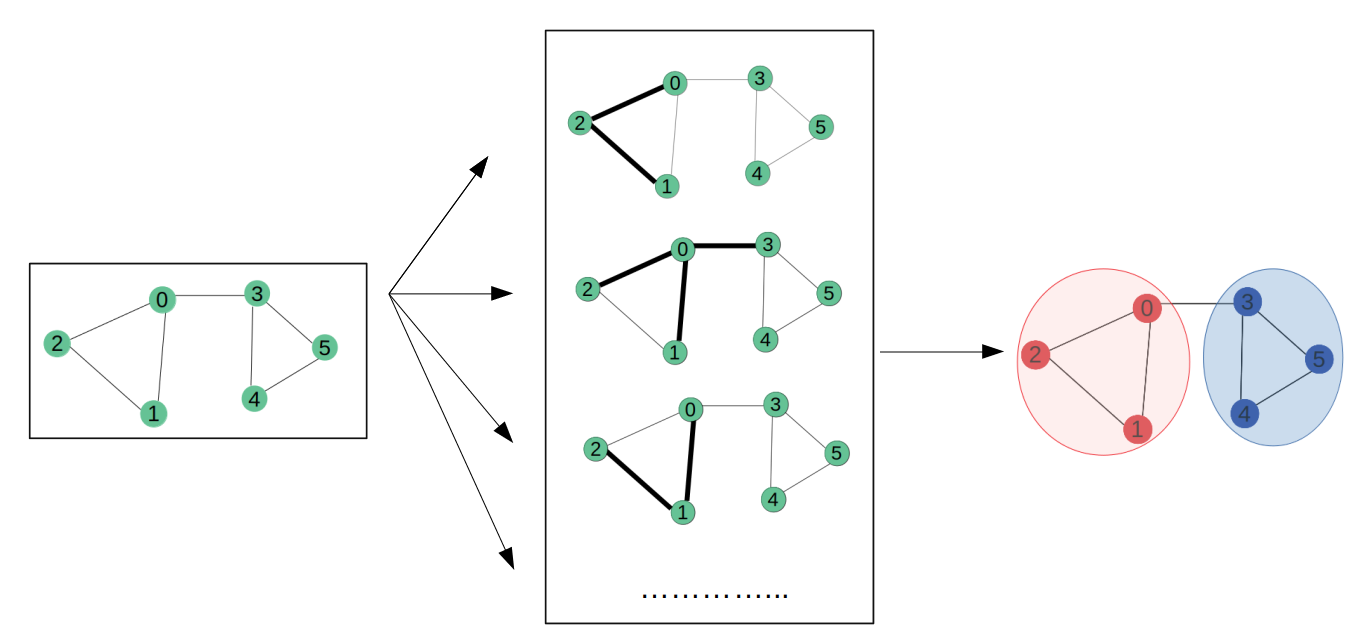
Motivation
Graph Convolutional Networks bring the idea of convolution to irregular domains. Derived from spectral graph theory, they aggregate information from a node's neighbors through a normalized propagation rule — powerful for semi-supervised learning on graphs.
Method
Each layer mixes node features using the symmetrically normalized adjacency matrix with self-loops, followed by a learnable linear map and nonlinearity. Stacking layers grows the receptive field across the graph.
\[ H^{(l+1)} = \sigma\!\left(\tilde{D}^{-1/2}\,\tilde{A}\,\tilde{D}^{-1/2}\,H^{(l)}\,W^{(l)}\right) \]
Mathematical core
The propagation rule is a first-order approximation of a spectral graph filter — a localized smoothing on the graph Laplacian. This spectral lens is where my interest in geometry and graph learning meets.