PixelCNN
Exact-likelihood image modeling, one pixel at a time.
Motivation
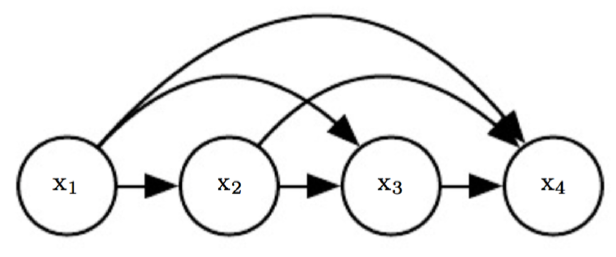
Autoregressive models factorize a joint distribution into a product of conditionals via the chain rule of probability. For images this means predicting each pixel from the pixels already seen — giving a tractable, exact likelihood at the cost of sequential sampling.
Method
PixelCNN enforces the autoregressive ordering with masked convolutions, so each output depends only on pixels above and to the left. Colour channels are handled with a further conditional factorization within each pixel.
Mathematical core
The chain rule turns density estimation into a supervised classification problem over pixel intensities. This exact-likelihood viewpoint is a useful contrast to the implicit likelihoods of GANs and the variational bounds of VAEs.