Optimal-Transport Flow Matching for Traffic Forecasting
A generative OT flow, stacked on a seasonal anchor, for long-horizon city traffic.
Motivation
My most recent project — a University of Padova deep-learning challenge — forecasts traffic across 66 sensors in Padova over long horizons (hundreds of 10-minute steps). The scoring metric is mean absolute error, which is minimized by the conditional median, not the mean. That reframing turns forecasting into a question about distributions, and makes a generative model the natural instrument.
Method
The model is a hybrid. A seasonal anchor captures day-of-week/hour/minute structure as a strong climatological baseline. A shared Transformer trunk attends across sensors — fed sensor geometry, time features, and learned embeddings. On top sit two heads: a deterministic residual head (median-aligned, L1) and a generative optimal-transport conditional flow-matching head. Predictions are combined by honest-holdout arbitration and stagewise stacking across five random seeds.
Mathematical core
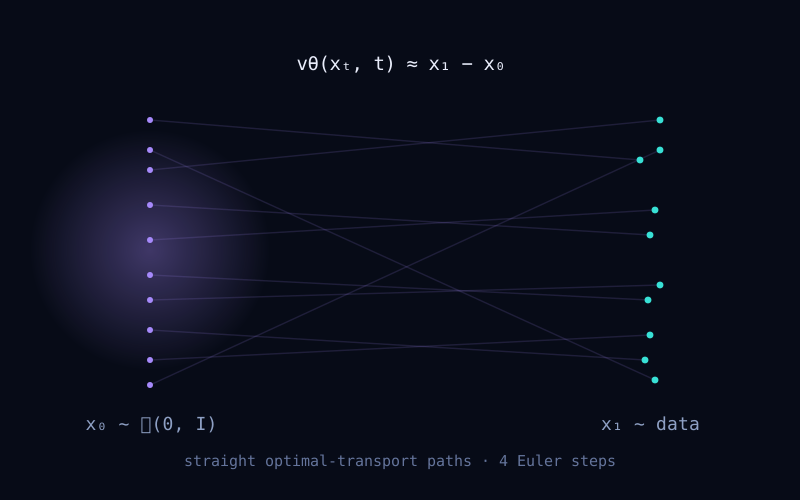
Flow matching learns a velocity field $v_\theta$ that transports noise to data along a probability path. Using an optimal-transport coupling of $x_0\sim\mathcal{N}(0,I)$ and data $x_1$ (here an exact 1-D minibatch OT / rank pairing), the interpolant becomes a straight line, its target velocity is constant, and just a few Euler steps integrate it accurately.
Inference & results
At inference the generative head samples $K$ noise seeds, integrates the ODE $\dot{x} = v_\theta(x,t\mid c)$, and takes the per-cell median — the statistically correct point estimate under MAE. Ensembling and honest validation guard every added parameter against overfitting. The project ties together the threads I care about most: optimal transport, generative flows, and the analysis of stochastic dynamics, applied to real structured data.