Expectation–Maximization
Fitting latent-variable models by iterated lower-bound maximization.
Motivation
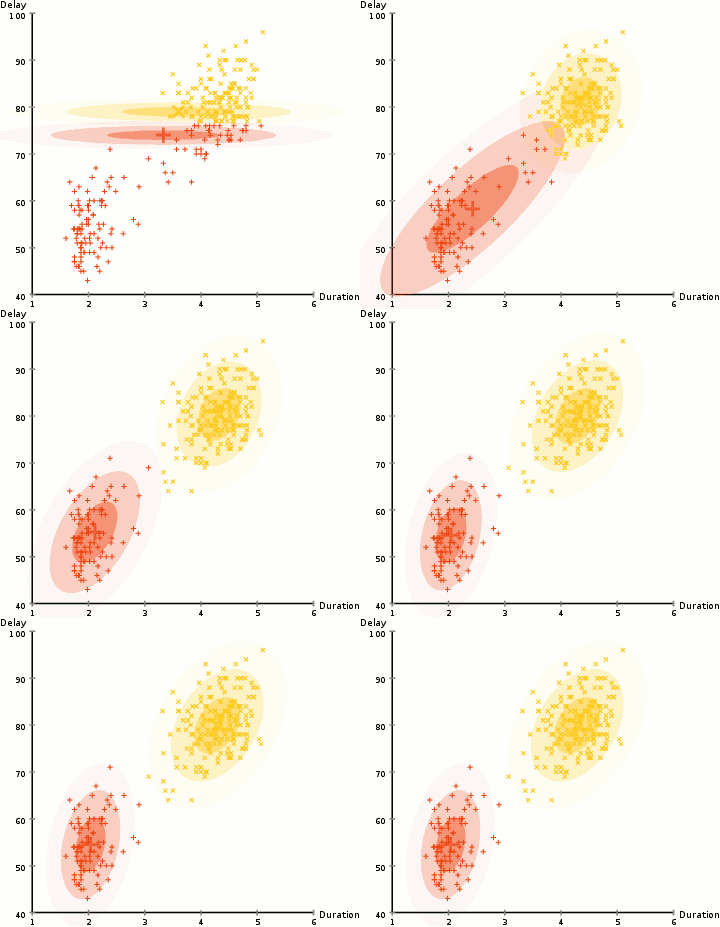
Expectation–Maximization is the workhorse for maximum-likelihood estimation when data are incomplete or governed by latent variables — Gaussian mixtures being the classic case. It alternates between inferring the latent responsibilities and re-fitting the parameters.
Method
The E-step computes the posterior over latent variables under current parameters; the M-step maximizes the expected complete-data log-likelihood. Each iteration is guaranteed not to decrease the observed-data likelihood.
Mathematical core
EM is variational inference in disguise: the E-step tightens a lower bound by setting the variational distribution to the exact posterior, and the M-step raises the bound. This makes it the natural stepping stone to mean-field VI and ADVI.